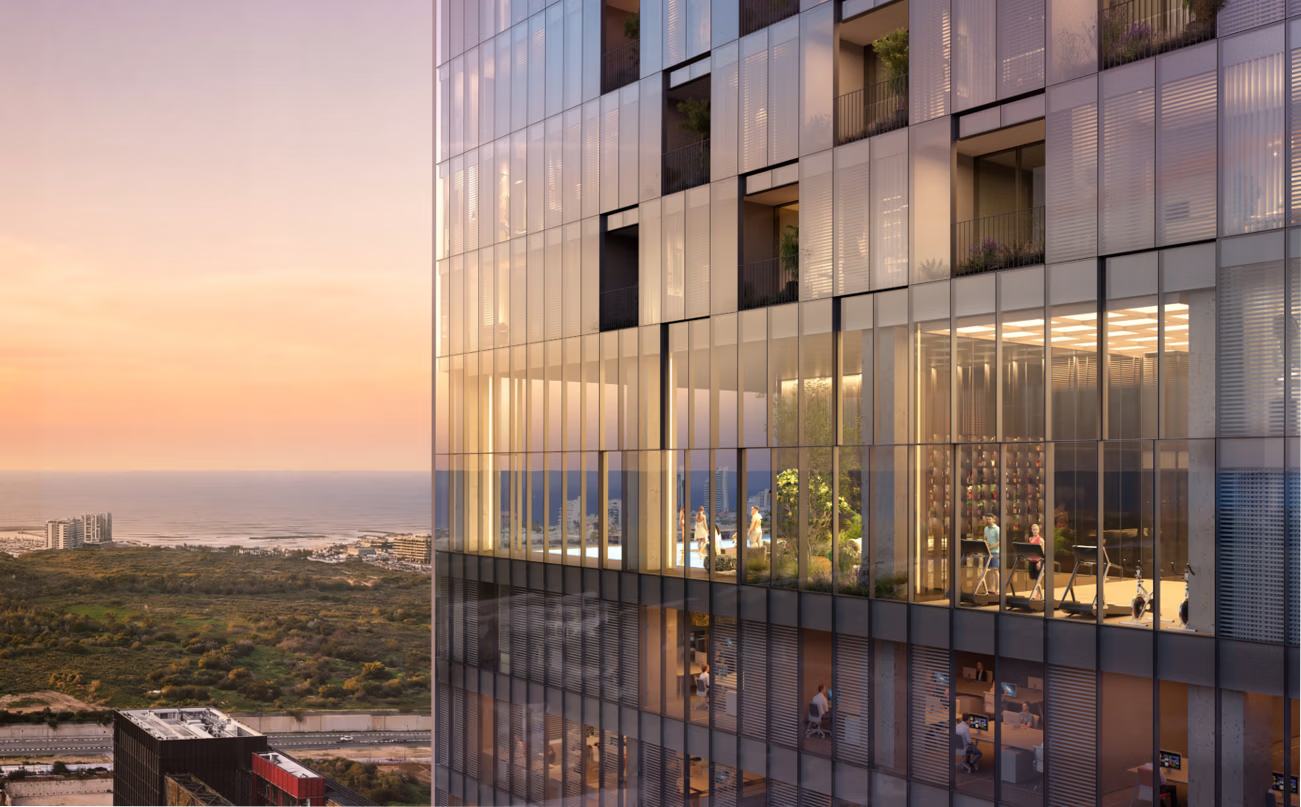
Most conversations about Israeli real estate start and end with apartments. That's a mistake, and an increasingly costly one, because some of the most sought-after properties in Tel Aviv over the last eighteen months haven’t been in residential towers. Now more than ever, investors are looking into commercial spaces to grow and maintain their business in Tel Aviv.
Israeli high-tech had, by most measures, a genuinely strong 2025: venture capital investment into Israeli companies rose roughly 30% year over year to $14.6 billion, exit value hit a record near $84 billion, and Israel ranked as the fourth-largest startup fundraising hub in the world, the largest outside the United States. Foreign direct investment into the country reached an all-time high of $26.2 billion, up 78% from 2024, with software, IT, and AI accounting for the overwhelming majority of that capital. None of that money stays purely digital either. A meaningful share of it eventually needs floor space, and in Israel, floor space for a growing tech company has one obvious center of gravity: Tel Aviv.
This is the commercial case, and it's a genuinely different investment thesis than the residential one. It deserves its own analysis rather than a footnote in a broader Tel Aviv guide.
The instinct might be to assume remote work permanently dented office demand here the way it did in parts of the U.S. and Europe. That hasn't happened in Tel Aviv, for reasons specific to the Israeli tech sector: intensely competitive hiring, a cultural preference among engineering talent for in-person collaboration, and, increasingly, a wave of defense-technology companies for whom secure, on-site office space isn't optional.
That last point deserves attention on its own. Defense tech absorbed a substantial share of Israeli office leasing in the first half of 2026, up roughly 32% from the preceding six months, with tens of thousands of additional square meters actively in demand. Rafael's move into a 100,000-square-meter tower at the Cosmopolitan development, and Palo Alto Networks' active search for 85,000 to 100,000 square meters of consolidated campus space in central Tel Aviv, are the kind of anchor leases that reshape a submarket's pricing for years.
Tel Aviv's commercial market isn't uniform, and the districts have sorted themselves by tenant type in a way that matters for anyone underwriting an investment.
Rothschild Boulevard and the CBD remain at the heart of Tel Aviv’s financial and business activity. Office rents here can reach roughly ₪95–130 per square meter per month, supported by demand from law firms, venture capital funds and companies that want a high-profile address close to the city’s historic commercial center.
Sarona and Midtown have become major commercial hubs, with newer, institutional-grade towers attracting companies looking for modern offices, strong infrastructure, and convenient light-rail access. Rents are generally lower than the Rothschild premium, while the newer buildings continue to benefit from demand from tech tenants.
Further north, Ramat HaHayal and Kiryat Atidim form one of Tel Aviv’s older tech and business districts. While the area may not have the same profile as the newer towers along the Ayalon corridor, it remains an established and active commercial market with a deep tenant base.
The Ayalon Highway corridor has become one of the city’s main destinations for large corporate leases, particularly in newer landmark towers. Companies such as Google and Monday.com have taken space here, with premium offices reaching roughly ₪180–220 per square meter per month and select landmark space approaching ₪250.
Strong pre-leasing activity has also been seen in some of the newest developments. One major tower, for example, was reportedly around 83% pre-leased before completion, pointing to continued demand for high-quality office space in this part of the city.
Just north of Tel Aviv, Herzliya Pituach is effectively an extension of the city’s wider commercial and technology corridor. Its Class A office market has historically maintained occupancy rates in the high 90% range, supported by its role as an established technology, R&D, and business hub for companies operating in the Tel Aviv area.
Commercial property in this corridor comes with a very different risk and return profile than residential real estate. High-quality office buildings with strong tenants, such as multinational tech companies, established defense firms, law firms, and financial services companies, can offer longer leases, built-in rent increases, and tenants with stronger financial backing than the typical residential renter. Yields on trophy properties with blue-chip tenants have fallen into the low 2% range, largely because investors are willing to pay more for that stability. The trade-off is lower yield in exchange for greater predictability.
You don’t necessarily need to buy an entire office building to get exposure to this market. Some investors buy smaller commercial units or individual office suites in mixed-use buildings, while others invest through a fund or syndicated deal focused on commercial property. There’s also a more indirect option. Residential areas like Sarona, parts of Rothschild and the neighborhoods around the Ayalon towers can benefit from the same growth in the local tech sector. As more companies and employees move into the area, demand for nearby housing can grow with it.
Commercial buildings often rely on a much smaller number of tenants than residential properties. If a building depends heavily on two or three large tech or defense companies, losing one of them can have a noticeable impact on occupancy and rental income. A company could relocate, cut back on office space or change its approach to hybrid work, and the effect can be much bigger than it would be in a residential building with dozens of separate tenants.
The Israeli high-tech sector bounced back in 2025 after two difficult years, but that doesn’t mean the market is immune to the ups and downs of the global tech industry. Funding activity in 2023 and 2024 was below the ten-year average, particularly when compared with the unusually strong 2021 and 2022 period. If investment and hiring slow again, demand for office space can eventually follow. Commercial leasing can also take time to react, so the impact may not be felt immediately.
Commercial properties generally change hands less often than apartments and tend to involve much larger amounts of money. That means there are fewer potential buyers and fewer comparable sales to use when figuring out what a property is actually worth. Smaller commercial units can be particularly difficult to price because there may only be a handful of similar transactions in a given area each year.
The demand for newer, higher-quality office space has created a clear divide in the market. Newer towers have benefited from companies looking for modern buildings and better amenities, while older Class B and C properties have already seen rents soften.
That makes the age and quality of a building important when looking at the market. An older office building may still have a Tel Aviv address, but that doesn’t automatically mean it will perform like the newer towers driving the headlines.
Commercial exposure to Tel Aviv's tech corridor is not a starter position, and we don't present it as one. It's a thesis for investors who already understand the Israeli real estate market's fundamentals, who have the capital base to either acquire meaningful commercial square footage directly or access it through a properly structured vehicle, and who are explicitly trying to diversify away from residential yield compression rather than stumbling into commercial property because a broker mentioned an available unit.
Our role here is less about sourcing a specific asset and more about the work that precedes it: assessing tenant quality and lease structure with the same rigor a private equity investor would apply to a portfolio company, stress-testing the assumptions behind a stated yield, and being honest when a commercial opportunity's pricing has already absorbed most of the upside a headline like "Start-Up Nation" implies. That's the advisory function that matters here, not finding you a listing, but making sure the numbers behind it actually hold up.
.svg)


.avif)


.svg)
.png)